🎉 Up to 70% Off Selected ItemsShop Sale
F.L.WRIGHT
By Bruce Brooks Pfeiffer & Peter Gössel
Hardback | 96 pages
Published: October 2015
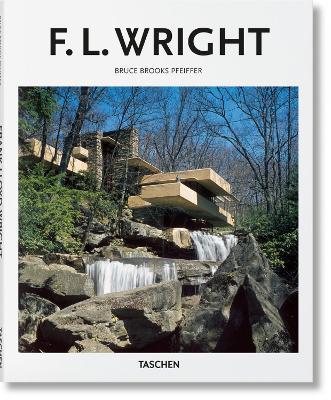
Widely thought to be the greatest American architect, Frank Lloyd Wright (1867-1959) was a true pioneer, both artistically and technically. At a time when reinforced concrete and steel were considered industrial building materials, Wright boldly made use of them to build private homes. His prairie house concept - that of a low, sprawling home based upon a simple L or T figure - was the driving force behind some of his most famous houses and became a model for rural architecture across America. Wright's designs for office and public buildings were equally groundbreaking and unique. From Fallingwater to New York's Guggenheim Museum, his works are among the most famous in the history of architecture.
Hardback | 96 pages
Published: October 2015
Widely thought to be the greatest American architect, Frank Lloyd Wright (1867-1959) was a true pioneer, both artistically and technically. At a time when reinforced concrete and steel were considered industrial building materials, Wright boldly made use of them to build private homes. His prairie house concept - that of a low, sprawling home based upon a simple L or T figure - was the driving force behind some of his most famous houses and became a model for rural architecture across America. Wright's designs for office and public buildings were equally groundbreaking and unique. From Fallingwater to New York's Guggenheim Museum, his works are among the most famous in the history of architecture.
Product Information
Product Information
Shipping & Returns
Shipping & Returns
F.L.WRIGHT
F.L.WRIGHT
By Bruce Brooks Pfeiffer & Peter Gössel
Hardback | 96 pages
Published: October 2015
Widely thought to be the greatest American architect, Frank Lloyd Wright (1867-1959) was a true pioneer, both artistically and technically. At a time when reinforced concrete and steel were considered industrial building materials, Wright boldly made use of them to build private homes. His prairie house concept - that of a low, sprawling home based upon a simple L or T figure - was the driving force behind some of his most famous houses and became a model for rural architecture across America. Wright's designs for office and public buildings were equally groundbreaking and unique. From Fallingwater to New York's Guggenheim Museum, his works are among the most famous in the history of architecture.
Hardback | 96 pages
Published: October 2015
Widely thought to be the greatest American architect, Frank Lloyd Wright (1867-1959) was a true pioneer, both artistically and technically. At a time when reinforced concrete and steel were considered industrial building materials, Wright boldly made use of them to build private homes. His prairie house concept - that of a low, sprawling home based upon a simple L or T figure - was the driving force behind some of his most famous houses and became a model for rural architecture across America. Wright's designs for office and public buildings were equally groundbreaking and unique. From Fallingwater to New York's Guggenheim Museum, his works are among the most famous in the history of architecture.
$7.05
Original: $20.15
-65%F.L.WRIGHT—
$20.15
$7.05Product Information
Product Information
Shipping & Returns
Shipping & Returns
Description
By Bruce Brooks Pfeiffer & Peter Gössel
Hardback | 96 pages
Published: October 2015
Widely thought to be the greatest American architect, Frank Lloyd Wright (1867-1959) was a true pioneer, both artistically and technically. At a time when reinforced concrete and steel were considered industrial building materials, Wright boldly made use of them to build private homes. His prairie house concept - that of a low, sprawling home based upon a simple L or T figure - was the driving force behind some of his most famous houses and became a model for rural architecture across America. Wright's designs for office and public buildings were equally groundbreaking and unique. From Fallingwater to New York's Guggenheim Museum, his works are among the most famous in the history of architecture.
Hardback | 96 pages
Published: October 2015
Widely thought to be the greatest American architect, Frank Lloyd Wright (1867-1959) was a true pioneer, both artistically and technically. At a time when reinforced concrete and steel were considered industrial building materials, Wright boldly made use of them to build private homes. His prairie house concept - that of a low, sprawling home based upon a simple L or T figure - was the driving force behind some of his most famous houses and became a model for rural architecture across America. Wright's designs for office and public buildings were equally groundbreaking and unique. From Fallingwater to New York's Guggenheim Museum, his works are among the most famous in the history of architecture.